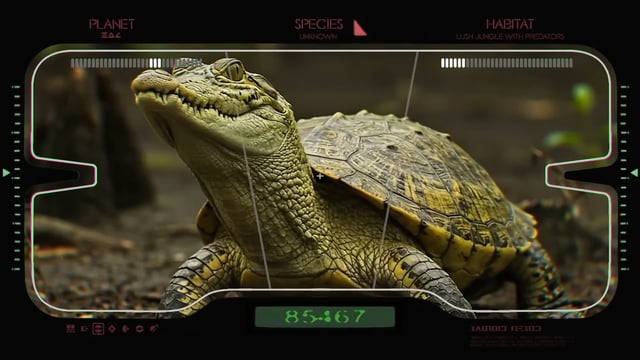
The image above is taken from a video Industrial Light and Magic premiered at a TED talk last month. The video, Star Wars: Field Guide, “explores what it would feel like if you sent a probe droid to a brand new Star Wars planet (sic).” The video accurately summarizes our entire society’s creative and spiritual death spiral.
Lucasfilm’s “Senior Vice President of Creative Innovation,” Rob Bredow, gave the talk. With a title like that, it’s no wonder he was chosen to evangelize the virtues of this sub-mental slop. It’s the kind of title that screams, “Congratulations on failing upward.” Control of “Creative Innovation” is something dictators give to their dumbest sons.
To be fair to Mr. Bredow, I’m sure he can read well enough. But I promise this position is because people above him think he’s a helpful tool—simple as that. But let’s stop mocking the messenger and start mocking the message.
Bredow starts by explaining the shot that opens Star Wars, the famous close-up of a Star Destroyer. Explanations of special effects in the golden age of the practical feel bittersweet. I enjoy learning how it was done, yet feel despair at knowing that in many cases it’ll never be done that way again. It reminded me of one day when I was going through the special features on a The Phantom Menace Blu-ray. It was listed as a fun fact for one of the spacecraft that “this ship is the last ship ILM ever made a model for in-camera use of.” God, that hit me like a gut punch.
But enough of the past; this TED Talk is about the future. Bredow next touches upon news reports on AI that express fears of automation. Bredow calls this reporting “sad.” I suppose, as Lucasfilm’s “Senior Vice President of Creative Innovation,” your job isn’t at risk.
To show how far AI has come, Bredow shows him two AI-generated “pictures” of a made-up woman giving a made-up TED Talk. He compliments the AI on how detailed the pictures are, given the simple prompts “Speaker on a TED Stage…” and “A wide-angle photograph, speaker on a TED stage.”. Has he ever wondered what happens if an AI receives the prompt “Ted Bredow gives a speech to Nazis”? I wonder if he would appreciate how the AI gave him five fingers in those photos.
Bredow also praises the work of companies like OpenAI in creating generative videos. After this, he discusses the history of Industrial Light and Magic. He begins this section with a clever little bit of rhetoric. He compares AI’s challenge with the obstacles faced in making Star Wars. AI’s challenge is that everyone hates it; George Lucas didn’t face this in 1977. This is a common and especially infuriating debate tactic of those evangelizing AI. They claim AI is unprecedented, then compare opposition to past anti-tech sentiments. They eat their cake and have it, too.
Bredow claims that ILM “brings artists and engineers together” to improve films. He then calls this approach “artist-driven innovation,” describing only about half of ILM. Of course, we all know why he didn’t want to include engineers and artists as the drivers of innovation. The way Bredow introduces the Field Guide indicates how Lucasfilm approaches AI-generated effects. In that case, such technology aims to eliminate the engineers of ILM. No longer will the artists and engineers be working “side-by-side”. Instead, the artists can input their prompts into the machine directly. The creator (engineer) is replaced by their creation (the software).
Next comes a series of heartbreaking anecdotes about CGI slop replacing practical effects. Seeing the first CGI dinosaur for Jurassic Park, Phil Tippett commented, “I’m going extinct.” While Tippet continued working in the industry, stop-motion is the way of the dodo.
Did you know that most practical effects technicians in Hollywood are unionized? Did you know that, until this year, almost no CGI technicians were? And that the studios’ big push to embrace AI coincides with an attempt among CGI artists to unionize? I’m sure this is all a big coincidence, of course.
One of Bredow’s points is that “innovations come when old and new technologies are blended.” He doesn’t seem to recognize how silly this sounds from an ILM corporate executive. This company has spent my lifetime dismantling the old ways of doing things. This is a company that, in twenty years, went from working with miniatures to this:
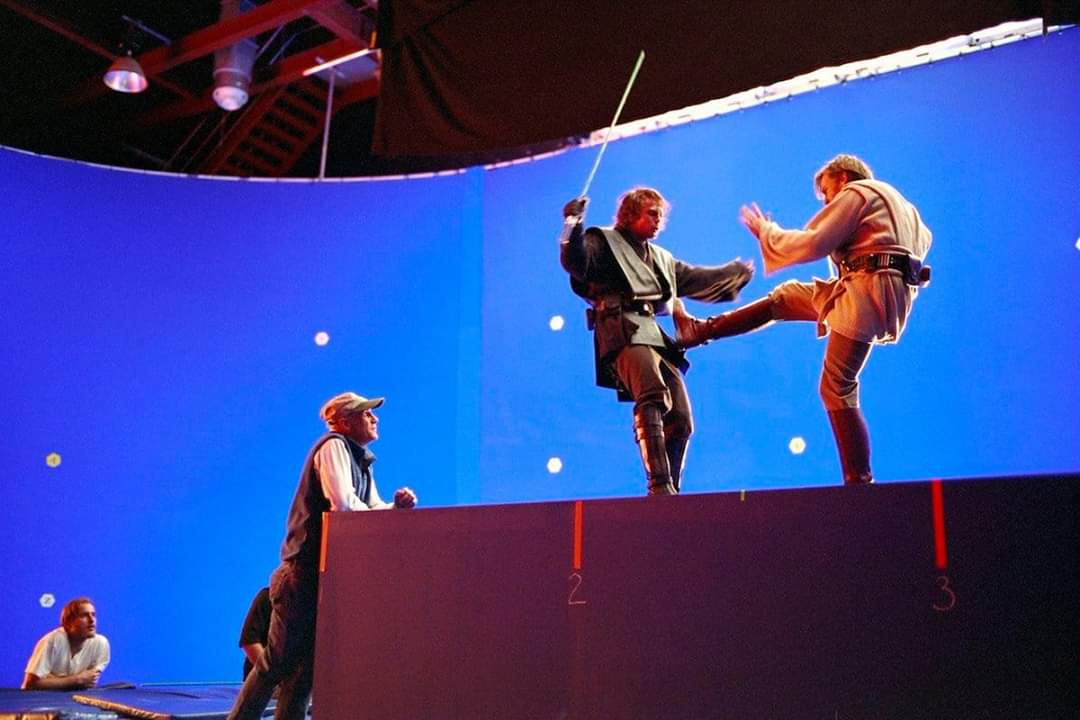
(This is a scene on the volcano planet, Mustafar. You can tell from the volcano that is there in the background.)
It’s also unserious to discuss blending old and new when the climax of your TED talk is an AI-generated short film. There is no blending there. Not of old and new special effects; not of human artistry and mechanical ingenuity.
We also cannot ignore those engineers’ artistic contributions to special effects. This will be eliminated in the new ILM AI paradigm simply because AI cannot contribute any input of its own. Generative AI has no interior world, so anything it contributes would only reflect what has already been put into it.
When AI automates a person’s job, it is the ultimate “fuck you” by their bosses. It is a tacit acknowledgement that they were never fully human to those who paid them. They were never more than a tool, and any creative spark they provided to their workplace was, at best, added value and, at worst, something their corporate overlords hated.
That is the ultimate insult of all ILM’s AI talk. It gives away how much the C-suite has come to hate the company they run. They want a new paradigm where they can input their bland prompts into an AI trained on everything and get something that inspires nothing in return.
 The Rattling Skeleton
Leave a comment